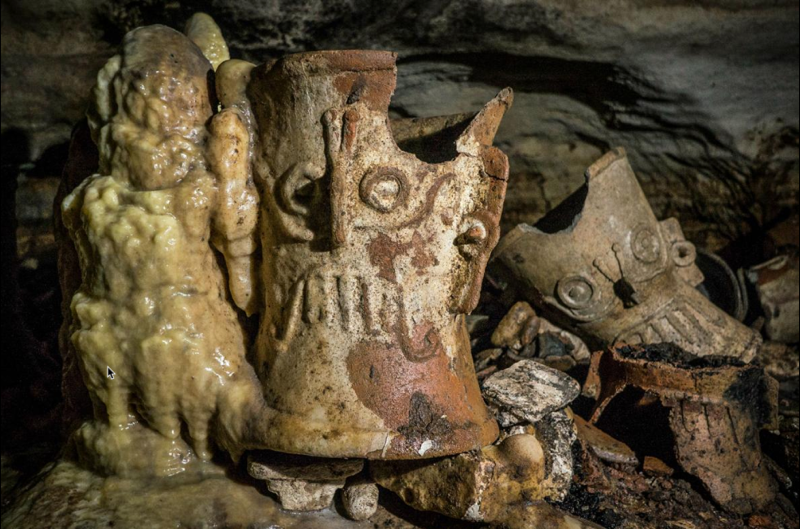
I love discoveries like these. It amazes me every time we discover something new about past civilizations. Archaeologists recently discovered more than 150 Maya artifacts in a series of caves Mexico’s Yucatán Peninsula.
Archaeologists hunting for a sacred well beneath the ancient Maya city of Chichén Itzá on Mexico’s Yucatán Peninsula have accidentally discovered a trove of more than 150 ritual objects—untouched for more than a thousand years—in a series of cave chambers that may hold clues to the rise and fall of the ancient Maya. The discovery of the cave system, known as Balamku or “Jaguar God,” was announced by Mexico’s National Institute of Anthropology and History
Balamku was first discovered by farmers in 1966 but remained sealed for more than 50 years until it was reopened in 2018. Incense burners, vases, decorated plates, and other objects were found. Check out the full story at National Geographic.
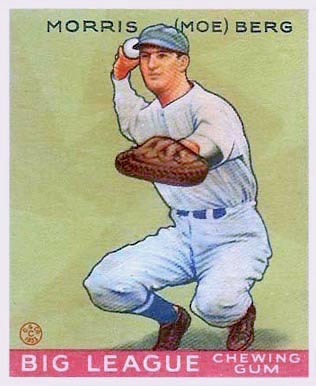
Baseball season is just around the corner so it seems fitting to talk about baseball. More specifically, a mediocre baseball player that was known as the "brainiest guy in baseball." A guy that graduated from Princeton and Columbia Law. A guy that went on to become a spy for the US government in Word War II. I'm talking about Morris "Moe" Berg.
It wasn't until the last year or so that I heard about Moe Berg. Actually, it was when I was browsing the IMDB credits of actor Paul Rudd that first brought Berg to my attention (more on that later). If I'm only looking at his baseball career, there's really no reason for me to know him. He was an average player that played at the beginning of the 20th century and never played for any St. Louis teams. It's his post-baseball life that I'm surprised never caught my attention.
Berg joined the Office of the Coordinator of Inter-American Affairs after the Japanese bombed Pearl Harbor. By this point, his baseball career was over, both as a player and a coach. Berg was seen as an asset due two previous trips to Japan with other ball players. He then went on to join the Office of Strategic Services, and the branch within the OSS called Secret Intelligence. He helped evaluate various resistance groups in Eastern Europe to determine who was the best suited to resist the Nazis.
In 1943, he was assigned to Project Larson. Project Larson was a program whose purpose was to kidnap Italian rocket and missile specialists and bring them to the US. Also part of Project Larson was Project AZUSA. AZUSA's goal was to interview Italian physicists to see what they knew about Werner Heisenberg and Carl Friedrich von Weizsacker. Per Wikipedia:
From May to mid-December 1944, Berg hopped around Europe interviewing physicists and trying to convince several to leave Europe and work in America. At the beginning of December, news about Heisenberg giving a lecture in Zürich reached the OSS. Berg was assigned to attend the lecture and determine "if anything Heisenberg said convinced him the Germans were close to a bomb." If Berg came to the conclusion that the Germans were close, he had orders to shoot Heisenberg; Berg determined that the Germans were not close.[45] During his time in Switzerland, Berg became close friends with physicist Paul Scherrer. Berg resigned from the OSS in January 1946. “Mr. Morris Berg, United States Civilian, rendered exceptionally meritorious service of high value to the war effort from April 1944 to January 1946,” reads the Medal of Freedom citation. “In a position of responsibility in the European Theater, he exhibited analytical abilities and a keen planning mind. He inspired both respect and constant high level of endeavor on the part of his subordinates which enabled his section to produce studies and analysis vital to the mounting of American operations.”
After Word War II, Berg worked for the CIA gathering information about the Soviet atomic bomb project. He was unable to deliver anything substantial.
Berg is such a fascinating guy. It's almost as if this is straight out of a movie, and you're not far off. That brings me back to Paul Rudd. In 2018, Rudd starred in a movie called The Catcher Was a Spy. The movie premiered at the 2018 Sundance Film Festival and had a limited release in the summer of 2018. I haven't seen the film and the reviews aren't that great (33% on Rotten Tomatoes), but iTunes has it for $6.99 if you want to give it a shot. There is also a book written about him with the same name.
I don't know how I missed this last year, especially since this is right up my alley, but Matt Baker at UsefulCharts published a chart on the evolution of the alphabet. Several times per week, if not per day, I wonder the origin of a word or phrase or food. I'm constantly curious as to how something came about. This chart, and corresponding video below, scratch an itch of learning new about history that I often get since leaving college. A history nerd is always a history nerd.
Before there was a Hot in Herre, there was Highway Farty and carn on the cob. No, I'm not having a stroke, I'm referring to the dialect that I heard as a child growing up in St. Louis. Citylab recently had a post explaining the St. Louis accent.
The most stereotypical St. Louis pronunciation is “farty” for “forty.” St. Louisans swap an “ar” for an “or” sound, so they eat “carn on the cob” and wish each other “good marning.” This is unique to St. Louis, but the city has other features in common with the Midlands. Older St. Louisans say “worsh” for “wash,” “wants off” for “wants to get off,” and “I waited on him” instead of “I waited for him.”
Growing up in St. Louis, I learned about Cahokia Mounds in school. It's fascinating how little we know about the settlement that was once North America's largest city. If you grew up outside Missouri or Illinois, you probably never heard about it at all.
A thousand years ago, huge pyramids and earthen mounds stood where East St. Louis sprawls today in Southern Illinois. This majestic urban architecture towered over the swampy Mississippi River floodplains, blotting out the region's tiny villages. Beginning in the late 900s, word about the city spread throughout the southeast. Thousands of people visited for feasts and rituals, lured by the promise of a new kind of civilization. Many decided to stay.
They didn't stay long though. By 1400, the city was abandoned and no one knows why. A group of archaeologists are attempting to unlock the mysteries of the Mississippian people. Check out the coverage on Ars Technica.
YouTube channel Now You See It published a great video about the rise and fall of Hollywood. It's a short video, so it is quick, top-level analysis that doesn't get too deep, but it does do a great job covering the more momentous parts of Hollywood as a whole, from moving from the east coast to the creation of big budget blockbusters.
Old Hollywood has always fascinated me (especially the old studio system and mob connections), so this was right up my alley.
Scientists have recently discovered a pair of wings that belonged to dinosaur-era bird ancestors encased in amber. From The Verge:
In a new study published in the Nature Communications journal this week, researchers say that the wings have very similar structures, coloring, and feather layouts as the wings of modern birds, despite the fact they likely belonged to 100-million-year-old avialans called enantiornithes.
X-ray scans indicate that the fossilized wings — found in northern Myanmar — likely belonged to juvenile creatures, and contain skin, muscle, and claws, as well as various layers of feathers, arranged in a markedly similar fashion to those of birds. That's not the only similarity: the feathers appear uniformly black inside the amber, actually show up in shades of brown, silver, and white under the microscope.
I love that discoveries like this are still being made. It gives us more insight into our planet's past.
Complex magazine has come up with a list of the best rapper for each year since 1979. It's crazy when you look through the '90s and see how much talent existed in the hip hop community. That fact becomes especially obvious when you start comparing the list to the 2000s - 2010s (Drake on the list multiple times, really?).
My personal favorite is, of course, Tupac.
1996 is a case study for every aspect of why 2Pac is so celebrated. He was a viable, competent artist in multiple arenas, and he had the discipline to incorporate his varied and conflicted missions into a single mantra. That savvy paid off in this year more than any other. It’s a shame that 2Pac’s ride had to end early, and on someone else’s terms, but the dedication to his craft that was on such full display in 1996 is why he’ll live forever.
I saw this video today on reddit and was blown away. The destruction is amazing and sad. I sent this to a coworker (who we may or may not give trouble for being German) and we discussed it briefly. She was telling me how there were few men around so the women lined up with buckets to remove the rubble. These women were called Trümmerfrau.
It is amazing that after all this time there are still cities being discovered. From National Geographic:
An expedition to Honduras has emerged from the jungle with dramatic news of the discovery of a mysterious culture’s lost city, never before explored. The team was led to the remote, uninhabited region by long-standing rumors that it was the site of a storied “White City,” also referred to in legend as the “City of the Monkey God.”
Archaeologists surveyed and mapped extensive plazas, earthworks, mounds, and an earthen pyramid belonging to a culture that thrived a thousand years ago, and then vanished. The team, which returned from the site last Wednesday, also discovered a remarkable cache of stone sculptures that had lain untouched since the city was abandoned.
So awesome. I wonder what we'll find out about this culture.
Interesting article about a prehistoric skull found in North Israel may finally prove that Neanderthals and modern humans lived together.
"It is the first direct fossil evidence that modern humans and Neanderthals inhabited the same area at the same time," said paleontologist Bruce Latimer of Case Western Reserve University in Cleveland.
"The co-existence of these two populations in a confined geographic region at the same time that genetic models predict interbreeding promotes the notion that interbreeding may have occurred in the Levant region," Tel Aviv University anthropologist Israel Hershkovitz said.
I love discoveries like this. It makes me wonder if we'll ever really know the full story of how we came to be.
Today is National Good Day Day. What is National Good Day Day, you may ask. Well, my dear friend, it is a day we celebrate every year in honor of the most perfect South Central day ever observed, on January 20th, 1992.
Murk Avenue breaks down the clues of Ice Cube's "It Was a Good Day" to pinpoint the exact day the song took place..
CLUE 1:
“went to short dogs house, they was watching Yo MTV RAPS”
Yo MTV RAPS first aired:
Aug 6th 1988
CLUE 2:
Ice Cubes single “today was a good day” released on:
Feb 23 1993
CLUE 3:
”The Lakers beat the Super Sonics”
Dates between Yo MTV Raps air date AUGUST 6 1988 and the release of the single FEBRUARY 23 1993 where the Lakers beat the Super Sonics:
Nov 11 1988 114-103
Nov 30 1988 110-106
Apr 4 1989 115-97
Apr 23 1989 121-117
Jan 17 1990 100-90
Feb 28 1990 112-107
Mar 25 1990 116-94
Apr 17 1990 102-101
Jan 18 1991 105-96
Mar 24 1991 113-96
Apr 21 1991 103-100
Jan 20 1992 116-110
CLUE 4:
Dates of those Laker wins over SuperSonics where it was a clear day with no Smog:
Nov 30 1988
Apr 4 1989
Jan 18 1991
Jan 20 1992
CLUE 5:
“Got a beep from Kim, and she can fuck all night”
beepers weren’t adopted by mobile phone companies until the 1990s. Dates left where mobile beepers were availible to public:
Jan 18 1991
Jan 20 1992
CLUE 6:
Ice Cube starred in the film “Boyz in the hood” that released late Summer of 1991, but was being filmed mid-late 1990 early 1991 and Ice Cube was busy on set filming the movie Jan 18 1991 too busy to be lounging around the streets with no plans. Ladies and Gentlemen..
The ONLY day where:
Yo MTV Raps was on air
It was a clear and smogless day
Beepers were commercially sold
Lakers beat the SuperSonics
and Ice Cube had no events to attend was…
This article is absolutely fascinating and depressing at the same time. St. Louis has experienced its own form of White Flight with folks moving from the city to county,[footnote]Or even further West with St. Charles, Lincoln, and Warren counties experiencing explosive growth over the past few decades[/footnote] which, to this day, still keeps the area pretty segregated, a point that was seen quite vividly with the Michael Brown case.
After emancipation, plantation owners relied upon sharecroppers to grow and harvest their crops. To keep the system in place, white leaders studiously kept out industries that might lure their laborers away from agriculture, as historian James Cobb reported in his seminal book about the Delta, The Most Southern Place on Earth.
Def Jam is 30 years old this year. Yes, 30. Rolling Stone sat down with co-founder Rick Rubin, returning to the very dorm room in which he started the label 30 years ago, to discuss how Def Jam began.
But now, thanks to modern forensic science, The Mail on Sunday can exclusively reveal the true identity of Jack the Ripper, the serial killer responsible for at least five grisly murders in Whitechapel in East London during the autumn of 1888.
DNA evidence has now shown beyond reasonable doubt which one of six key suspects commonly cited in connection with the Ripper’s reign of terror was the actual killer – and we reveal his identity...
Jack the Ripper has been identified as Polish-born Aaron Kosminski, one of the 6 original key suspects of the murders.
If this turns out to be true, this is very interesting. Unfortunately, this means he didn't die in St. Louis.
As an amateur historian and hip hop aficionado, I found the research of what day in history is actually Ice Cube's "Good Day" fascinating. Murk Avenue breaks down the clues of Ice Cube's It Was a Good Day to pinpoint the day.
CLUE 1:
“went to short dogs house, they was watching Yo MTV RAPS”
Yo MTV RAPS first aired:
Aug 6th 1988
CLUE 2:
Ice Cubes single “today was a good day” released on:
Feb 23 1993
CLUE 3:
”The Lakers beat the Super Sonics”
Dates between Yo MTV Raps air date AUGUST 6 1988 and the release of the single FEBRUARY 23 1993 where the Lakers beat the Super Sonics:
Nov 11 1988 114-103
Nov 30 1988 110-106
Apr 4 1989 115-97
Apr 23 1989 121-117
Jan 17 1990 100-90
Feb 28 1990 112-107
Mar 25 1990 116-94
Apr 17 1990 102-101
Jan 18 1991 105-96
Mar 24 1991 113-96
Apr 21 1991 103-100
Jan 20 1992 116-110
CLUE 4:
Dates of those Laker wins over SuperSonics where it was a clear day with no Smog:
Nov 30 1988
Apr 4 1989
Jan 18 1991
Jan 20 1992
CLUE 5:
“Got a beep from Kim, and she can fuck all night”
beepers weren’t adopted by mobile phone companies until the 1990s. Dates left where mobile beepers were availible to public:
Jan 18 1991
Jan 20 1992
CLUE 6:
Ice Cube starred in the film “Boyz in the hood” that released late Summer of 1991, but was being filmed mid-late 1990 early 1991 and Ice Cube was busy on set filming the movie Jan 18 1991 too busy to be lounging around the streets with no plans. Ladies and Gentlemen..
The ONLY day where:
Yo MTV Raps was on air
It was a clear and smogless day
Beepers were commercially sold
Lakers beat the SuperSonics
and Ice Cube had no events to attend was…
Tests found that the DNA of some villagers in Liqian, on the fringes of the Gobi Desert in north-western China, was 56 per cent Caucasian in origin.
Many of the villagers have blue or green eyes, long noses and even fair hair, prompting speculation that they have European blood...
The genetic tests have leant weight to the theory that Roman legionaries settled in the area in the first century BC after fleeing a disastrous battle.
The clash took place in 53BC between an army led by Marcus Crassus, a Roman general, and a larger force of Parthians, from what is now Iran, bringing to an abrupt halt the Roman Empire's eastwards expansion.
Thousands of Romans were slaughtered and Crassus himself was beheaded, but some legionaries were said to have escaped the fighting and marched east to elude the enemy.
They supposedly fought as mercenaries in a war between the Huns and the Chinese in 36BC – Chinese chroniclers refer to the capture of a "fish-scale formation" of troops, a possible reference to the "tortoise" phalanx formation perfected by legionnaries. The wandering Roman soldiers are thought to have been released and to have settled on the steppes of western China.
The theory was first put forward in the 1950s by Homer Dubs, a professor of Chinese history at Oxford University.
I've talked a bit about the history of hip hop music and how it quickly evolved into a profitable form of music, but no other company was able to capitalize on hip hop like Def Jam Records, and no other person could have done it like Russell Simmons.
In 1984, Simmons candidly told Gary Harris, a former Def Jam executive, “I’m sick of making people rich. I want to own my own shit, my own record label, my own movie company.” [1. The Men Behind Def Jam] It was this mentality that drove Simmons to find Rick Rubin. When Simmons found Rubin, he was surprised to find a white kid, but then “realized that Rick Rubin and I had a lot in common.” [2. Life and Def: Sex, Drugs, Money + God] Simmons decided to ask Rubin to co-produce an album by RUN-D.M.C., a group that Simmons was working with that also included his brother, Joseph Simmons. RUN-D.M.C. were probably the most popular and successful hip hop act of the time, but that did not mean they garnered much chart success. It wasn’t until Rick Rubin convinced the boys of RUN-D.M.C. to collaborate on a song with Aerosmith. The result was “Walk this Way,” which became the first rap record to appear in heavy rotation on MTV. By this time, Simmons knew he did the right thing in pairing up with Rubin, even though Simmons had been working with the group prior to meeting Rubin, and the group was never signed to Def Jam. His mind was made up, and with visions of success in his eyes, he went to create Def Jam Records with Rubin, using the signature name and logo that Rubin had come up with for the T. La Rock & Jazzy J record.
Simmons and Rubin each put up four-thousand dollars for the formation of Def Jam Records. Simmons immediately started using his contacts from his promotion and management business, Rush Management, to gain the attention of Billboard magazine. Def Jam was officially founded in the summer of 1984. Simmons stated that, “The purpose of this company is to educate people as to the value of real street music by putting out records that nobody in the business world would distribute but us.” [3. The Men Behind Def Jam] Surprisingly, it was their work with people not on the label that gave them their initial notoriety. It was working on the album King of Rock by Run-D.M.C. that gained Rubin and Simmons recognition from major labels interested in what Rubin and Simmons were doing with the new phenomenon called hip hop. Not only was Simmons having huge success as a concert promoter, manager of such acts as Kurtis Blow and Run-D.M.C., but he also orchestrated one of the first hip hop clothing partnerships.
Simmons and Lyer Cohan, who worked for Simmons’ Rush Management and would become head of Def Jam Records, set up a deal with German shoe manufacturer, Adidas. While playing at New York’s Madison Square Garden, Run-D.M.C. played thousands of fans, and the two Adidas representatives, the group played their song “My Adidas,” a song about the preferred shoes of the group. When the song came on, the thousands of fans in the Garden took off their Adidas and held them in the air. This was quite impressive to Adidas, impressive enough to offer a deal to the group. The Run-D.M.C. Adidas were shipped in a black box with no laces, the style that was set by the group. If not for Simmons, hip hop’s first sponsorship deal might not have been made.
About the same time that Rubin and Simmons started meeting with major labels for distribution, a young MC from New York came to the attention of the pair. He was LL Cool J, real name, James Todd. Rubin started working with the sixteen year old when Todd refused to quit calling Rubin to see if he had listened to his demo, a demo that had been sitting un-opened in a pile in his NYU dorm room. Rubin finally gave it a chance and saw Todd becoming the next big thing. After recording some tracks, Rubin and Simmons saw Todd as the future and decided to take the song “I Need a Beat” to Los Angeles for a meeting with associates from Warner Brothers Records. According to Simmons, when they put on LL Cool J’s “I Need a Beat,” “the whole room just sat there- some of them stared at the speakers, some of them just sat looking at their hands. It was like they were hearing music from another planet.” They left the building that day without a distribution deal with Warner Brothers. But before they left LA, they were playing “I Need a Beat” twelve times a day on KDAY, which had recently become an all-rap format station. [4. Life and Def: Sex, Drugs, Money + God] This success with an un-established artist later helped pave the way for negotiations with CBS Records. “I Need a Beat” was just the first of seven singles released that first year by Def Jam. After meeting with CBS, they settled at a six hundred thousand dollar promotion and distribution deal. [5. The Men Behind Def Jam] Todd’s next single, “Rock the Bells” went on to sell over nine hundred thousand copies, his biggest single to date. [6. Ibid.]
Coming up Next: Movin' on Up. Def Jam Moves Out of the Dorm and into the Corporate World.
In my last post you learned a little about the beginnings of hip hop music as a business. While the song Rapper's Delight might have sold two million copies world wide, the industry still saw hip hop as a fad that wouldn't last. Rapper's Delight could not be replicated. Many people felt differently. One of them became one of the most successful people in hip hop. That man was Russell Simmons.
Russell Simmons was brought up in Hollis, Queens. His father, Daniel, was supervisor of attendance in Queens School District 29. Russell Simmons studied sociology at the Harlem branch of City College. It was there that he teamed up with fellow student Curtis Walker to throw parties in Harlem and Queens at which the first generation of rappers competed. He went on to manage Walker, who as Kurtis Blow became the first big solo rap star in 1979. Simmons worked with Blow in the completion of “Christmas Rappin.’” He also managed other successful acts such as Run-D.M.C., Will Smith, as DJ Jazzy Jeff and the Fresh Prince, as well as legendaries DJ Hollywood and DJ Kool Herc.
“Christmas Rappin’” was Simmons’ first time of his illustrious career, that he entered the studio. When the song was completed, Simmons began shopping it around to various labels for release. As Simmons said in Life and Def: Sex, Drugs, Money + God, “There was interest, but no one was biting. The industry’s attitude was that “Rapper’s Delight,” despite its US sales and international appeal, was an unrepeatable fluke. [1. The Men Behind Def Jam p 53]
While it was a fluke for the artists that recorded the song, the genre was by no means a fluke. “Christmas Rappin’” gained moderate success on radio. In places around the South, the single was still being played in late July. Simmons, who needed distribution for the record, approached PolyGram to distribute it. PolyGram wasn’t interested in investing in a hip hop record, but Simmons decided to show them the power of hip hop. He decided to go around to the various stores that expressed interest in the record and told them to order the record from PolyGram. When PolyGram started receiving orders from stores, they saw this as an immediate opportunity to cash in on hip hop. Kurtis Blow signed a record deal with Mercury Records, a label under the PolyGram umbrella. This marked the first time a hip hop act was signed to a major label. [2. Ibid]
Sugar Hill Records did find some more success on their roster. The legendary Grandmaster Flash and the Furious Five signed to Sugar Hill Records and made its mark in hip hop in 1980. The group released the record “Freedom” which hit the top 20 on the R&B charts. 1981’s “The Adventures of Grandmaster Flash on the Wheels of Steel” was the first record to feature complex cuts and scratches, and introduced the name Grandmaster Flash as their originator. But it was 1982’s “The Message” which became the first hip-hop social commentary on ghetto life, and which became a critical crossover hit for Grandmaster Flash and the Furious Five. [3. Grandmaster Flash: Biography] Meanwhile, Simmons was out on tour with Blow promoting the “Christmas Rappin’” single. Though Blow had two Gold singles (sales of five-hundred thousand each), hip hop was still far from the minds of the major labels in the industry. They still didn’t see it as a marketable form of music. Simmons thought differently and would soon form a partnership that would change the fate of the entire music industry.
In 1984 two very different people with very different backgrounds met and would come to create one of the most successful musical ventures in the industry’s history. Not only was it that successful, but it was successful with a music the major labels didn’t see as becoming successful. The first guy was Rick Rubin, a former punk musician who loved the rebelliousness of this new form of music. The other was Russell Simmons, the concert promoter in New York who was booking the hottest MCs and DJs of the time at small venues, parties, and other small gatherings. These two met when Simmons saw a little logo on an album by T. La Rock & Jazzy J. This logo read “Def Jam.” The record was nothing like Simmons had ever heard. He immediately began searching for the producer of this record. He tracked Rubin down and found out he attended New York University. It was in a NYU dorm room that he met Rick Rubin and formed a partnership that would change music history.
Stay tuned for the next segment in my series on hip hop history, Building the Empire.

 Before there was a Hot in Herre, there was Highway Farty and carn on the cob. No, I'm not having a stroke, I'm referring to the dialect that I heard as a child growing up in St. Louis.


